Clocking in at just under 90 seconds, if this arrangement of the timeless carol doesn’t make you smile, then you are a grinch, or you cannot appreciate the most noble of all the brass instruments: the trombone. This song and album has special significance for me because it was recorded in the auditorium of the school where I did my undergrad in L.A. and features all the top studio trombone players from Hollywood and the greater Los Angeles area. We were allowed to sit in the back during takes and watch these guys play.
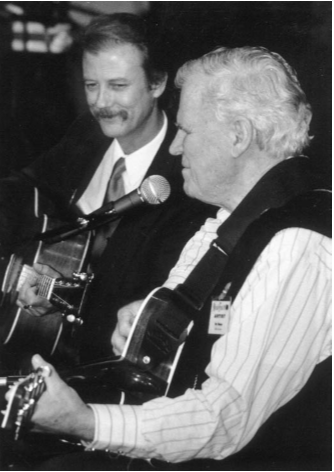
For some reason, I used to think tabs, or tablature was a form of “cheating”. For those of us who struggled to learn how to ready Western notation on the 5 line 4 space staff, a system of lines to represent strings and numbers to represent frets or fingers seemed too easy. “And it doesn’t even account for rhythm…” I now realize how stupid this thinking was, especially when I started playing guitar flat picking style. Salt Creek is one of a hundred or more tabs I downloaded and learned to play over and over with a metronome. I could never play as fast as Doc or Tony or do the string crossings and other fancy runs, but the tab was a big help to at least get the melody right.
Today is the first day of Advent. Typically I would be singing The “O” Antiphons Liturgy: an Advent Procession with Lessons and Carols at St. Mark’s Cathedral here in Seattle:
The annual “O” Antiphons Liturgy is considered by many to be a highlight of the liturgical year at Saint Mark’s. The particular form of this liturgy that we use was invented here, first presented in 1986, and is today used by churches around the world. It is structured around the seven medieval antiphons, each beginning with the word “O ,” which also form the basis of the Hymn “O Come O Come Emmanuel.” This beloved cathedral tradition provides a moving and evocative entrance into the Advent season of prayerful expectation.
The Pandemic has cancelled this beautiful service for singers and worshippers in person but will be reimagined online at this link at 7:00pm tonight. You may even see me singing on the final hymn “Veni, Veni Emmanuel”. The service from last year is posted below.
Today’s post is an arrangement of a choral piece by Paul Manz, and is one of my favorite Advent choir anthems. I think it translates beautifully for the Mandolin.
2019 O Antiphons service, St. Mark’s Cathedral Seattle
Cobain didn’t know it when he wrote the song, but Teen Spirit is a brand of deodorant marketed to young girls. Kurt thought Hanna was complimenting him on his rebellious spirit, as someone who could inspire youth. Sales of Teen Spirit deodorant shot up when this became a hit, even though it is never mentioned in the lyrics.
Before they recorded this, DJ Dimitry wrote to Bootsy Collins and sent him a tape. Collins, a funk pioneer who recorded with George Clinton, liked it and flew in to play bass. He appeared in the video. Collins recruited fellow funk-masters Maceo Parker and Fred Wesley to play on this. Parker played sax and Wesley trombone. The rap in the middle is Q-Tip, who was a member of A Tribe Called Quest at the time. He has been a guest rapper for many artists, including De La Soul, Mariah Carey, and The Beastie Boys.
This track comes from a CD that I no longer have or can find anywhere. Produced in the late 90s early 2000s by Marsh Hill Fellowship here in Seattle, it was some of the most original worship music at a time when Contemporary Christian Music was pretty dismal.
Ten was Pearl Jam’s first album. They were very efficient in the studio, getting most songs done in just a few takes, but “Even Flow” was an exception, requiring at least 50 takes. Pearl Jam was a band with itinerant drummers, and Dave Krusen, who was their stickman at the time, had a hard time with this track. Said Krusen: “They had to edit the middle because I was speeding up at the end. It was just a nightmare.”
This song and the entire album is a soothing balm during these pandemic times. If you need to quiet your mind or soul, check out this track.
Many of us say we’re fine when we’re not. Many of us don’t want to talk about how vulnerable we feel. Sometimes it’s too complicated to explain in a way that does justice to those sets of feelings. It’s too long a story to tell. Sometimes, it’s just easier to say “I guess I’m doing fine” than it is to tell that whole story. This song cuts right to the heart of that state of mind. Maybe that’s another reason this song and Sea Change as a whole seemed to make such a positive impact on listeners. The song helps to tell many stories about loss and the process people go through to manage it. It does this so that we as listeners don’t have to. And isn’t that why we gravitate towards art in the first place?
The rhythm was a John Lee Hooker riff that we sort of straightened out. It wasn’t copied, it was inspired. You only get in trouble if you steal people’s melodies and words, as Led Zeppelin did. We all loved John Lee Hooker. Without people like him, Elmore James and Robert Johnson our repertoire would be pretty lean.

:format(jpeg):mode_rgb():quality(90)/discogs-images/R-15703817-1596225713-4929.jpeg.jpg)

:format(jpeg):mode_rgb():quality(90)/discogs-images/R-3247932-1534086856-3069.jpeg.jpg)
:format(jpeg):mode_rgb():quality(90)/discogs-images/R-367084-1263095553.jpeg.jpg)
:format(jpeg):mode_rgb():quality(90)/discogs-images/R-1016561-1284453721.jpeg.jpg)
:format(jpeg):mode_rgb():quality(90)/discogs-images/R-367664-1408907054-7204.jpeg.jpg)
:format(jpeg):mode_rgb():quality(90)/discogs-images/R-9436063-1601141525-2266.jpeg.jpg)
:format(jpeg):mode_rgb():quality(90)/discogs-images/R-710013-1397922334-4683.jpeg.jpg)
:format(jpeg):mode_rgb():quality(90)/discogs-images/R-5661898-1399257846-4473.jpeg.jpg)
 Song a Day 2020